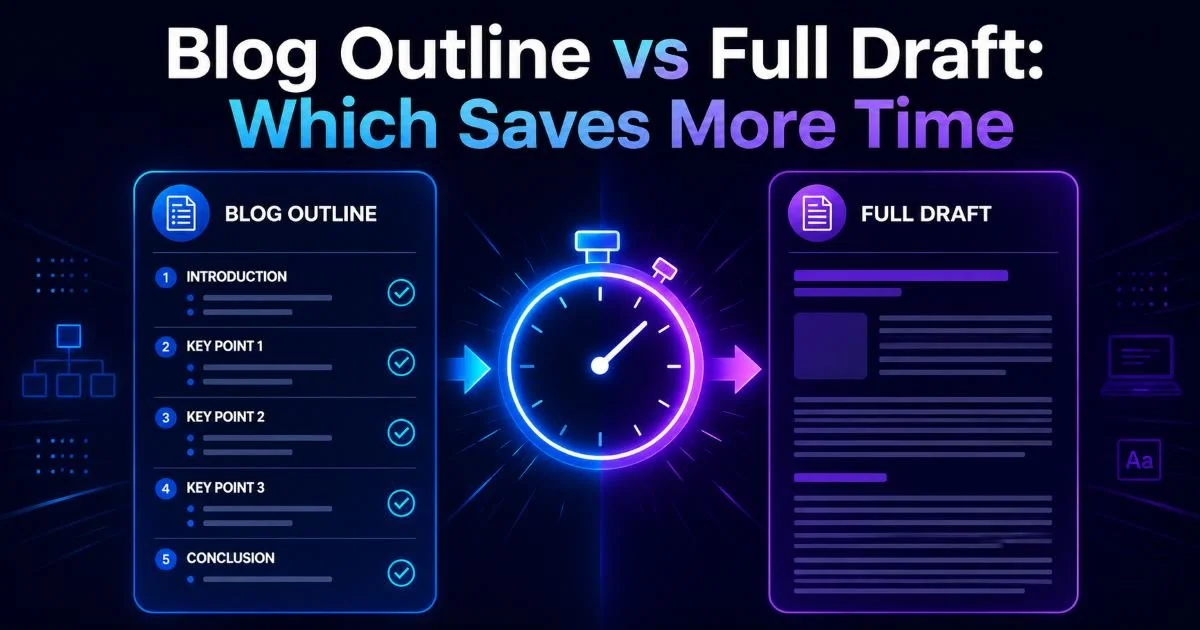
Blog writing with templates and content planning tools has become standard practice for anyone who publishes regularly. But a persistent debate divides bloggers: should you invest time in a detailed outline, or just power through a full draft? The answer affects your productivity, your content quality, and how quickly you can hit "publish."
Both approaches have vocal advocates. Outline enthusiasts say structure prevents wasted effort. Draft-first writers argue that momentum matters more than planning. If you're wondering which method actually saves more time, especially when paired with blog post templates that provide definition, examples, and a working framework, this comparison will give you a clear answer.
Key Takeaways
- Outlines reduce revision time by up to 40% compared to unstructured first drafts.
- Full drafts work better for experienced writers who already think in structures.
- Templates combined with outlines produce the fastest total writing workflow.
- Draft-first approaches often lead to scope creep and off-topic tangents.
- Your best method depends on post complexity, not personal preference alone.
Speed and Efficiency: Which Gets You to "Publish" Faster?
The Outline Advantage
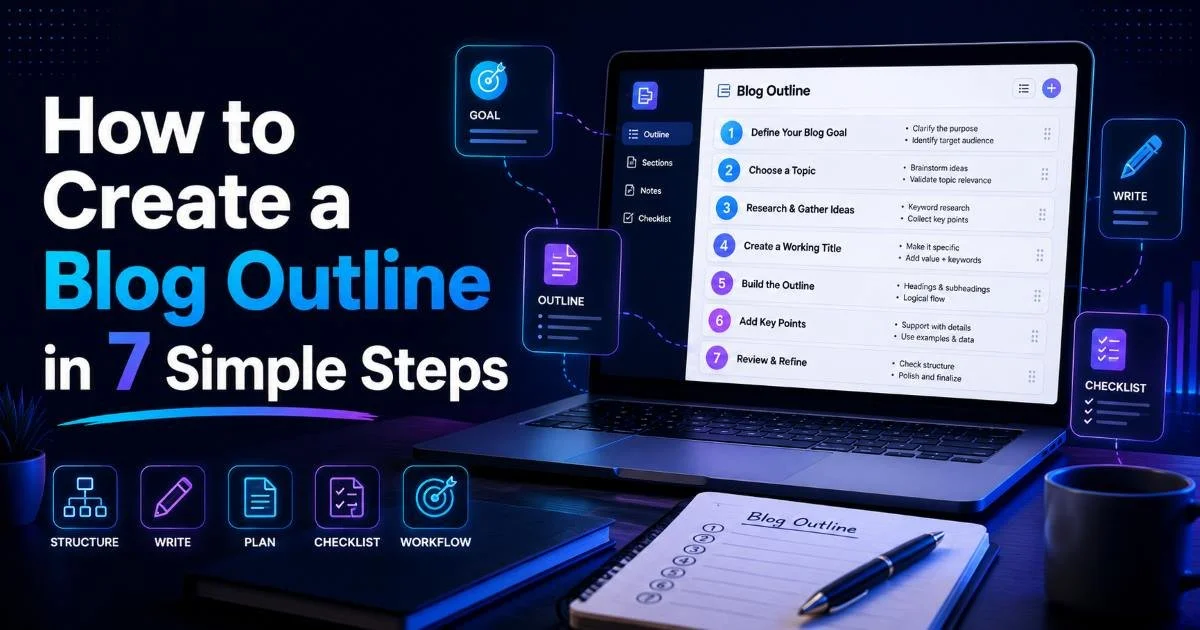
An outline forces you to make structural decisions before you write a single paragraph of body content. You decide on your main points, arrange them logically, and identify gaps in your argument. This upfront investment typically takes 15 to 30 minutes for a standard 1,500-word post. If you need a step-by-step process, creating a blog outline in 7 simple steps can cut that planning phase down to under 20 minutes.
The time savings compound during the actual writing phase. Writers who outline report spending 25% to 40% less time on their first draft because they aren't stopping to figure out what comes next. The outline acts as a roadmap, eliminating decision fatigue mid-sentence. You spend your cognitive energy on word choice and argumentation rather than on structure.
The Draft-First Case
Draft-first writers argue that outlining is just writing with extra steps. For someone who can hold an article's structure in their head, jumping straight into prose eliminates the "planning" phase entirely. This approach works especially well for short posts (under 800 words) or topics the writer knows inside and out. The raw draft might be messy, but it exists, and that matters.
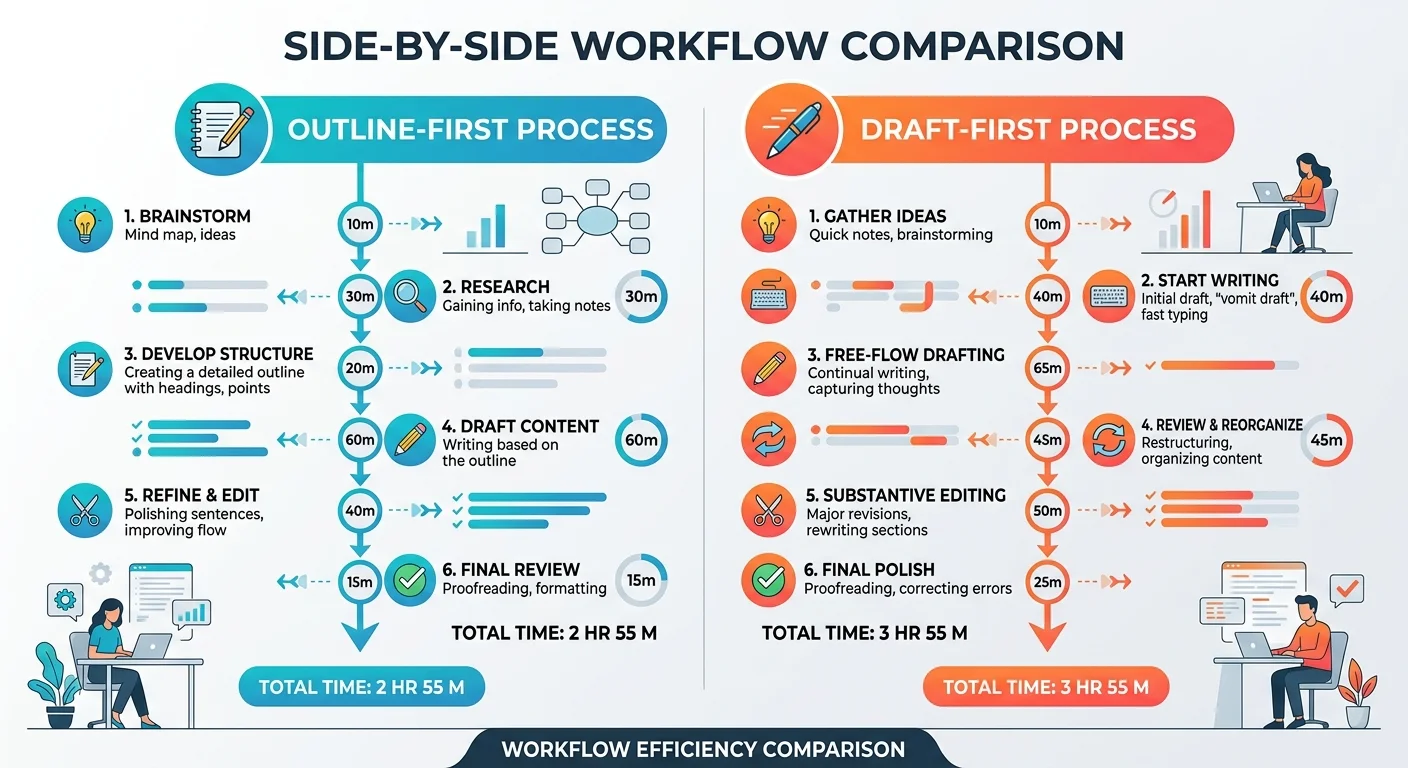
However, the total time from start to published piece often tells a different story. A draft-first approach may produce 1,500 words in 90 minutes, but those words frequently need heavy restructuring. When you factor in the revision time, the "fast draft" often takes just as long as outline-plus-draft. Speed during the initial writing phase doesn't always translate to speed across the full workflow.
Track your total time from first word to published post for five articles using each method. The data will settle the debate for your specific workflow.
Content Quality and Structure
How Outlines Shape Quality
Outlines give you a bird's-eye view of your content before you commit to prose. You can spot logical gaps, redundant sections, and missing transitions while they're still just bullet points. This is far cheaper (in time and emotional energy) than discovering a structural problem 1,200 words into a draft. Writing templates amplify this advantage because they provide pre-built section frameworks that you can customize.
When you combine content planning with writing templates that actually work, you also get consistency across your blog. Every post follows a recognizable pattern. Readers know what to expect, search engines can parse your structure easily, and you build topical authority post by post. This consistency is nearly impossible to maintain with a draft-first method unless you have extraordinary discipline.
When Drafts Surprise You
Fairness requires acknowledging that some of the best blog content comes from exploratory writing. When a writer truly understands a subject, a free-flowing draft can produce insights and connections that a rigid outline might prevent. Creative or personal posts often benefit from this looser approach. Opinion pieces, narratives, and thought leadership content sometimes need room to breathe.
The risk, of course, is that not every draft session produces gold. Some produce meandering, unfocused content that needs to be rebuilt from scratch. For beginner and intermediate bloggers, this inconsistency is the real cost. If you're still developing your voice, blog post templates for beginners paired with outlines give you guardrails that prevent wasted sessions without stifling your creativity.
"The best workflow isn't the one that feels fastest during writing; it's the one that gets quality content published with the least total effort."
Revision and Editing Burden
This is where the comparison becomes most lopsided. Outlined posts typically require one round of editing focused on prose quality: tightening sentences, improving transitions, and polishing the introduction. The structure is already sound because it was validated before writing started. Revision takes 20 to 30 minutes for a well-outlined 1,500-word post.
Draft-first posts, by contrast, often need structural revision before line editing can even begin. You might discover that your third section actually belongs first, or that two sections cover nearly identical ground. Restructuring a complete draft is frustrating work. It requires cutting paragraphs you spent real time crafting, and it's psychologically harder than rearranging bullet points in an outline.
| Editing Factor | With Outline | Without Outline |
|---|---|---|
| Structural revisions needed | Rare (under 10%) | Common (over 60%) |
| Average revision rounds | 1 to 1.5 | 2 to 3 |
| Time spent on revisions | 20 to 30 min | 45 to 90 min |
| Risk of scrapping sections | Low | Moderate to High |
| Consistency with brand voice | High | Variable |
The numbers make a clear case. Even if outlining adds 20 minutes to the front end of your process, it saves 25 to 60 minutes on the back end. That math holds whether you're writing weekly or daily. The editing burden is the hidden cost that draft-first advocates often undercount because revision feels like a separate task. It isn't. It's part of the same project.
If you use AI tools for editing, an outlined post still wins. AI editors like those covered in this roundup of the best AI SEO tools perform better when content already has clear structure and logical flow.
One more factor deserves attention: collaboration. If you work with an editor, a VA, or a content team, an outline lets you get structural feedback before investing hours in prose. Sending someone a 15-bullet outline for review takes them five minutes. Sending a 1,500-word draft takes them thirty. This efficiency multiplier grows with team size and publishing frequency.
Best Use Cases for Each Approach
The honest answer to "which is better" depends on what you're writing and how experienced you are. For complex, research-heavy, or comparison posts (like this one), outlines are almost always the smarter choice. They prevent the architectural mistakes that cost serious revision time. Posts with multiple data points, subheadings, and internal logic practically demand advance planning.
Draft-first writing holds its own for shorter content, personal reflections, and topics where the writer has deep expertise. A seasoned blogger writing a 600-word opinion piece about their own industry probably doesn't need an outline. They've internalized the structure through years of practice. The key word there is "seasoned." For most bloggers at the beginner to intermediate level, that internalized structure hasn't formed yet.
Check Also Using AI Blog Writing Tools for Content at Scale
There's also a hybrid approach worth considering. Some writers create a "skeleton draft," which is essentially an outline with a few key sentences or transitions written in. This method gives you structural confidence while maintaining some of the creative momentum of drafting. It works particularly well with blog post templates, where the template provides the skeleton and you fill in the substance section by section.
Ultimately, the method you choose should reflect the specific post, not a blanket philosophy. Keep outlines as your default for anything above 1,000 words or anything with a defined structure (comparisons, tutorials, roundups). Reserve the draft-first method for shorter, more personal, or highly familiar content. This flexible approach gives you the best of both worlds without dogma slowing you down.
Don't confuse "I enjoy drafting more" with "drafting is more efficient." Enjoyment matters for sustainability, but track your actual time before committing to one workflow.
Frequently Asked Questions
?How do I track total time from draft to publish accurately?
?Does combining a blog post template with an outline actually save more time than either alone?
?How much extra revision time does skipping an outline really add?
?Is draft-first writing ever the smarter choice over outlining?
Final Thoughts
For most bloggers producing content regularly, outlining saves more time than jumping into a full draft. The math is straightforward: a small upfront investment in planning prevents a much larger revision cost on the back end.
When you pair outlines with writing templates and solid content planning habits, the efficiency gains compound across every post you publish. Start with an outline, write faster, edit less, and publish with more confidence.
Disclaimer: Portions of this content may have been generated using AI tools to enhance clarity and brevity. While reviewed by a human, independent verification is encouraged.